StudioWeb was designed and refined, to allow teachers with no prior coding knowledge, to be able to teach a classroom with confidence. I can set up a free trial, so you can review StudioWeb. Just let me know.
We provide courses in 3 programming languages:
Python
JavaScript
PHP
The courses are beginner to intermediate level. So we should be able to accommodate the mixed level of students you have in your classroom.
For your Python aware students, you can have them work on the web languages (HTML, CSS and JavaScript) … which will compliment their Python skills. You could also have them do our Python course, because it will likely give them another point of view, regarding Python. I cover some more advanced Python topics in that course, like using modules and object oriented programming.
For your beginners, you can have them either start with Python, then continue into the web languages, as your more advanced Python students have. Or, you can have them start with the web languages:
HTML5
CSS3
JavaScript
… To be able to do JavaScript, students need to know HTML5 and at least some CSS. We cover all of the above.
Cost:
$10 per student per course or $20 per student for all the courses you need. Most go with the $20 option and teach:
HTML5
CSS3
JavaScript
Python
We also have certifications in the above languages at an extra cost of $35/student per certificate. Though we have been providing certification services for schools since 2011.
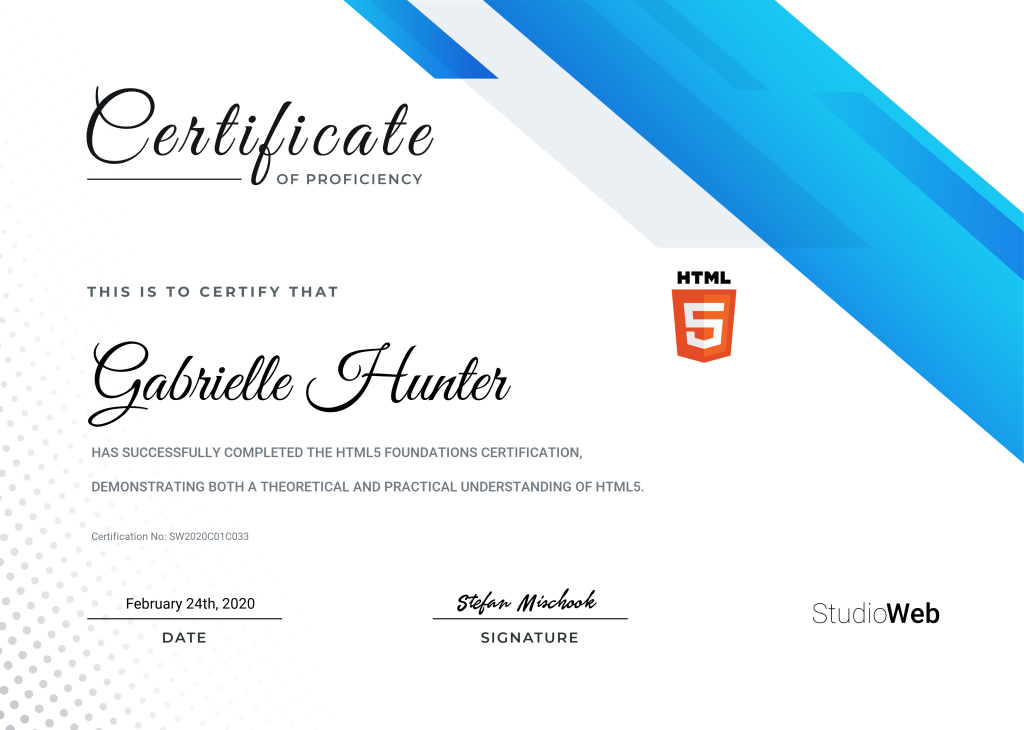
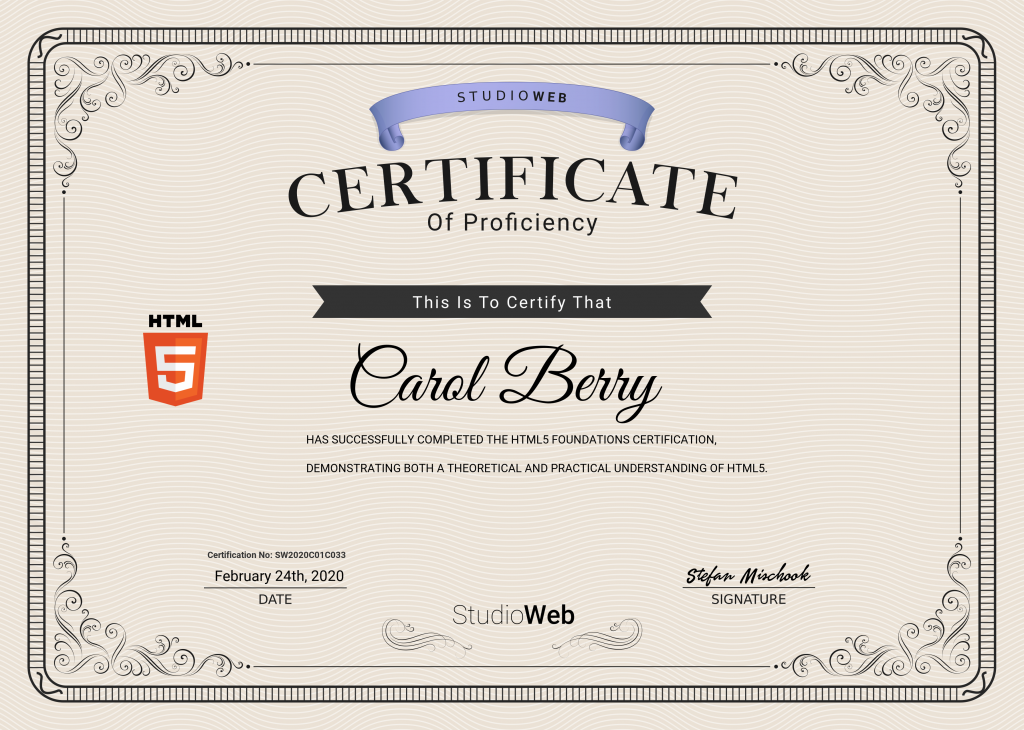
Here are some samples of the printable certification students will earn when they pass a certification exam:
Many a young developer believe that it is crucial that you use the most advance languages and frameworks for your development work, else your apps will be total garbage! If you won’t take our word for it, at least listen to some of regrets of what could be your next employer…
Full transparency: This is mainly for the young ‘nerdling-devs’ who feel like they have something to prove, but it could apply to anyone really…
So, we thought we’d throw out another PSA about how using the most cutting edge tech is not always the best idea. That “language that will make all the difference”, doesn’t necessarily exist. Essentially, that “there is no stack that is universally better than the other [and] that everything is very circumstantial: for certain tasks, certain languages are better.”
But today we thought instead of wearing out the same letters on our writer’s keyboard, we’d try a little negative reinforcement… Today we’re gonna hit you where it hurts: your wallet. Then were show you your potential employers and how they got hurt in the wallet, and why their hurt will always dictate how and what you do (which I would argue then turns into an existential hurt which will forever linger ever so slightly in the back of your mind and weigh down your soul just a little …so bonus negative reinforcement -I win forever- Boom!…Sorry.).
It comes down to this, whatever new tech you think is soooo cool, and you want immerse yourself in, do that on your own time. The companies that you work for or will freelance your time out to will not use it. They will use either OLD (read: tried and true) tech or something that they have invested thousands or millions into and are not going to give up. You wanna make money: learn to use their tech. Period.
Still on the fence? “One of the advantages nobody points out is that old technology can mean job security, or job opportunity. If all the young hipster nerdlings are jumping into some brand new cutting edge tech, a lot of the times, there’s not too many jobs in that.” Whereas if a company invested a lot of money running their business on an older language, there’s probably not a lot of programmers out there anymore for it, and that would be an abundance for you!
Still not convinced? Alright, hail-mary throw: “I am very reluctant to adopt any new technology, just like any other business is…and the reason they’re very reluctant to adopt a new technology is not because they’re ‘old school’, or they’re dumb, or because they don’t see the advantage… It’s because they look at the broader picture [what you should do as a developer]. The broader picture is that you don’t want to find yourself using a stack that never really catches on fire; that never really takes off. Imagine if you spend 50 grand, 100 grand, a million building an application, and your business depends on that application, using some cutting edge tech and you find out 4 years later that nobody wants to use it anymore. Happens all the time… And then you’re stuck: cuz good luck trying to find new people [programmers], and if you find people they’re going to charge you an arm and a leg… and you’ve got this investment in this technology and you’re stuck: you have to rewrite from scratch, or you have to pay through the nose to find people. …Even worse is if the technology doesn’t take off, you may find yourself with an abandoned technology; and then you’re in big trouble!”
So there it is, we’re sorry we had to do that you…it was outta love. Check out the VLOG for a way more in depth dive into this. And good news: the newsletter is up! subscribe to get access to stuff you can’t get on YouTube (links down below). -Enjoy!
Sign up to my Need2Nerd Newsletter for exclusive nerd content that everyone loves: https://www.need2nerd.com/
What is the quickest and easiest way to learn React JS? The key is to learn the web fundamentals.
Full transparency here, we’re going to be talking ourselves up a bit and shamelessly plugging our courses, because we got a question that directly references them. Our questioner (questionee?) was wondering if it was easy to jump into React after taking our WebDev (web development) course?
Quick (but not necessarily deep) jump into React:React (also known as React. js or ReactJS) is a JavaScript library for building user interfaces. It is maintained by Facebook and a community of individual developers and companies. React can be used as a base in the development of single-page or mobile applications.
And as for how easy or how much of a ‘shift’ it would be to jump into React after learning with our web development course? “[My WebDev course] …is designed to give deep knowledge that you can use to pivot into many directions. React, of course, is a natural progression because you need to know JS (JavaScript), HTML, CSS, and the web in general: I teach all this and much more”.
This also speaks to something that’s been mentioned a lot on these VLOGS and articles, so much so, that’s it should be considered one of our mantras here: “the key to becoming a great developer quickly is to master the fundamentals. I teach the fundamentals. Painstakingly put in a lot of effort to make my fundamentals courses very, very thorough; you’re going to see that they cover so much more than any tutorial out there could possibly cover, and that’s because of the nature of the courses.” That includes HTML5, CSS3 and of course, JavaScript and once you have those basics down, learning React JS will be easy.
So yeah, we’re blowing our own horn a little, but hey, we put in the work and it’s nice to reap the rewards. The reward being in this case, knowing that this person is going to have an easier time learning something they really want to learn (possibly getting a better job), and that our course(s) helped them!
Check out the VLOG for some more insight and check out our links down below to the courses offered. We want them to work for you so we took the time to do it right. Believe us, we gain nothing as a business if you learn nothing, it’s worth a look! -Enjoy!
Show up on time, deliver your code on time, and learn to properly estimate how much time a project will take.
A revolutionary rock band from 1994 once said, “Time is wasting, time is walking…”, and while time did eventually get its revenge on them, their warning should not go unheeded. “…in any business, and in life: whether you’re freelancing, whether you’re working for somebody: show up on time.”
We can extrapolate even further with this little nugget, because the ‘show up on time’ mentality also leads us to other positive behaviors. “It also means doing what you say. So don’t promise you’re going to deliver in 3 weeks, and then deliver in 6 weeks.” Now this can be tricky because we want to deliver good work, but we don’t want to keep the client waiting (it’s not good for them or for you, trust us), so how do we compromise? “You gotta work hard to make sure that in your estimates you hit those milestones as you promised. So one of the tricks is to overestimate the amount of time it’s gonna take to do something: So let’s say you figure it’s gonna take you a month to complete a project, tell your client it’s gonna take you 2 months -so if you get it done in a month: fantastic!” And if things go wrong, and you get it done in a month and a half, you’re still okay…
The VLOG will give you even more tips, and expand on them for dealing with clients (whether freelancing or ‘9 to 5-ing’). Also, in a quick flash of shameless self-promotion; please check out our complete freelancer course. It’s the best way to take advantage of decades of experience (speaking of time) and turn it into little digestible bits, and you just know there’s going to be a part in it about time management. -Enjoy!
What lessons do 25 years of coding impart? Harken younglings! The wisdom drawn from the ancient past.
First things first; Thank you Blizzard for not suing us. This title is really a testament to the enduring warmth of the characters you have created. And wouldn’t it be lovely if a young programmer eventually found their way to work for you because of a this blog…?
Alright, onto the imparting… is everyone still harkening? Great.
1. You will learn much more when you start getting paid to code: So among the new programmers or people just learning to program/code, there’s this idea that you need to show up with a full and infallible knowledge right out of the gate. “That’s why you see people get caught up in all these tutorials, because they’re insecure about their level of skill, so they keep doing more tutorials, more tutorials, more tutorials… Real world coding is about learning as you go -especially in the first 3-5 years as a software developer.” Now just so you don’t think that it’s all hand-holding and singing bible hymns around a campfire, “One of the number one skills of a good developer, by the way, is that they’re able to learn quickly.” So, while you are completely allowed to make mistakes and correct them, depending on where you work, you will be expected to pick up certain skills in an ‘amount’ of time…
2. The best code is simple code: If you’ve been following the VLOG or BLOG, you know that we bring this up every 2 or 3 posts, but it is important. No one cares about your flashy hijinx because, “The best developers write simple code. Why? Because code has to be updated a lot of times, especially in a valuable concept, and if you have complex code then that’s going to be a nightmare to maintain, very expensive to maintain and more prone to to bugs. So strive to write simple code.” Think of it this way, if you came onto project and were asked to update someone else’s work, wouldn’t you want to see simple and easy to read code? Not only is it professional, but think of it as a courtesy…
3. Coding real world apps is an iterative process: No one writes perfect, untouchable code in one sitting. Be prepared to do a few passes. Things change and things need updating. “Every time you do a pass, you refine the quality of the code. So that’s why when you develop your app (alpha), you want to get the whole working app out the door as quickly as possible: fully functional …because that way even if you’ve got parts of it really written badly, having that fully functional app (even if it’s crippled), it gives you insight into what the app ultimately should be.” In the beginning (the alpha stages), you really have only a limited idea of what the project should be, or how it will come together. “When you are writing code, you wanna get from A to Z -get the whole thing functional- then you start refining it, refining it. As you learn about the use case (how the app should be used/structured), then you can start writing more solid code. [The idea being] that with each pass the quality of the software will improve.”
4. Nobody wants to write good docs[documentation], but they should: This should be a ‘no-brainer’, let’s say you’re taking a class, you’ve shown up all semester and done all the in-class assignments. Then the test rolls around and you open your note book to look at your notes and there’s either nothing there or just drawings of sweet-ass guitars on fire, descending from the heavens for you to grab while you’re riding your red dragon into battle…(you know, non-specific stuff, that I totally didn’t draw in high school physics). It’s arguable that you are going to be screwed for the test ahead, and that’s how we feel about documentation. “Good documentation is huge because it will help you remember why you made certain architectural decisions in the code, and will help you transfer the knowledge to the next set of people who might get on the project. So if you have software that’s going to be successful in anyway, you wanna have good documentation -it’s just so important in terms of the quality of the project.”
So there it is young warriors, check out the VLOG where you can get this knowledge straight from the wizard’s mouth, plus more in depth ramblings…ah…epiphanies…yeah… . If you’re interested in learning more, please check out the links down below to our courses in web development, learning Python, or even freelancing, and entrepreneurship. They also make a great gift for that someone on the fence that just needs a little nudge. Fight the good fight and keep that code clean and simple. -Enjoy!
What makes a web app successful? The development process and the realities of real-world coding.
You’ve probably seen or heard a lot of stories about a businesses’ web project (or projects in general) failing. Heck, if you’re a freelancer chances are you’ve witnessed it firsthand! It’s a more common occurrence than you think, especially with small businesses. “…You do all kinds of work, you put out a beautiful website or you put out a beautiful web app, and then you link to it in your portfolio from your own website, and the next thing you know -bing, bing, boom- the client instead of calling you up to try and make updates, they try to tweak it themselves of they hire their kid; they get the kid to come in there and they try to fix it and they mess it up, and in a short period of time the site looks terrible.”
So why does this happen? Well, believe it or not, it doesn’t come from a purely bad place in terms of the intention. That is to say, your client isn’t trying to ‘F#%$’ you or your work, or your livelihood for that matter. It actually (for the most part) comes from a place of ignorance: they just don’t know…anything, really…including how much it actually costs. “A lot of people who jump into the game of building a website or building a web app -any app- they don’t really realize how much work it really is to refine the product, to get it to the point where it’s really ready for market.”
Sound familiar? Here are some pitfalls that have unfortunately cut down many a project in the prime of their lives (and some even before that).
Versions and Iterations: Microsoft has Windows10, so what happened to windows 1-9? Yup, they were previous versions that were replaced by (theoretically, arguably, etc.) newer, better, faster versions. Products and projects must evolve or improve (bugs, glitches, etc.), or the user will simply not want to use it and go somewhere else. Which brings us to our next point
UI and UX: Now depending on the company or client you work for, they might like to lump these two things together but trust us, they are two very different things. UI (user interface) is pretty much the look of things what the user sees: colors, designs, fonts, formatting -the eye candy, so to speak. But UX (user experience) is how easy it is to use, and that is the real draw to a product or project. You could have the most appealing, eye-catching, awe-inspiring design, but if you can use it: if it’s clunky, takes forever to load, or your users just have no idea how to start or where to go to get what they need, it’s useless.
Poor Budget Planning: This last one is almost always the case (especially with getting the ‘kid’ in to do your work). “When a lot of small business owners realize they’re gonna have to invest much more into the project, a lot of them will drop the project in that point in time. I’ve had clients who spend fifty grand, 100 grand on a project, they get it out there and it’s starting to get some traction but they’re not willing to put more into it, so the system kind of sleeps and slowly fades and dies away.”
And on that positive note, check out the VLOG!! It goes into way more detail on these points and uses clear cut examples like MySpace, and Google, and StudioWeb! There’s also a mention of how to bill small companies for your time in case a project does go down in flames, you won’t go into bankruptcy. Speaking of UI and UX, check out our online courses [links below…shameless promo, I know…], as a great example and who knows, ya might even learn something…
Contrary to what the title would suggest, we’re not trying to pit software developers against programmers in an all out brawl to the death in a post-apocalyptic forum for our amusement… *mental note for the end of the world*
No, what we’re presenting here is the subtle and (sometimes) not so subtle differences between the jobs, tasks, and expectations of these careers so that you can know what’s right (or interesting) for you when thinking about which path you may want to take.
We will also mention the role of architect and scriptor but the VLOG itself will go into way more detail about these jobs. Also, be ready for some shameless promotion because this is pretty much our milieu (area of expertise) here, and our courses reflect that.
Before we get started, I just want to point out that we are speaking in generalities, and yes, it’s quite possible that the position in your company or your freelancing gig has you filling different roles. These jobs can be quite fluid and we are only going to speak to what’s generally expected of you in these roles…
“A software developer is someone who is able to create entire systems, while a programmer (can also be a software developer), [but more likely], is someone who just writes code and can write programs. A software developer would develop an entire web app from scratch, would be able to design all the different layers, etc. … A software developer [in a nutshell] is a very experienced programmer… A lot of very experienced programmers never become software developers because they don’t go to that level, they work on very specific things here and there and they don’t develop entire architectures.”
A scriptor is someone who writes very simple lines of programming code. Little bits of Python code to automate software, a lot software out there (video rendering engines, etc) they’ll use Python to control how the software operates (batch operations, etc.), and that’s traditionally someone you would call a scriptor, because they’re writing little scripts (short pieces of code). And there’s a lot of demand for that as well!”
Software architects are quite literally architects of the software. They may not have time to do the task of the software developers, programmers, or scriptors, but they take care of the overall, top-down structure. For example, they could pick the languages, the frameworks, they get into the nitty-gritty with the lead developer, going over the best way to tackle situations/problems. Look, if you’re a software developer, and once a week (or more) you have a meeting with someone who you bring problems to, or someone who points you in certain directions or chooses the very foundational cores from which you work in…chances are they’re the architect.
And here’s the [SHAMELESS PROMO]: The courses we offer, “I think it’s more directed towards making you a [software]developer rather than just a scriptor or a programmer. Because they get into all those big picture issues, I help you understand the choices that you make as a developer (or a programmer), and why and how [for example] does JavaScript fit into this equation, into the stack, what’s it used for… And what I’ve seen, a lot of other course they don’t touch on that. They say here’s some JavaScript, we’re going to create a bouncy game and that’s it! But they don’t show you how to use it in the real world. That to me is super important, so that’s integrated into what I teach.”
So there you have it. Again, the VLOG goes into way more detail, we recommend you check it out. And no matter what you choose to be, check out our courses because they are made to give you the tools to see the bigger picture, which is always good. Believe me, you want to be overqualified for your job, people notice that and usually want to put you in a better position…or just pay you more money. -Enjoy!
Can you still make money as a freelance web designer in 2019-2020?
No clever title today, young devs… We received an email that had so many good, topical questions that we decided we didn’t have time to get ‘cute’ and just wanted to dive right in…
Is freelancing web design still viable in 2019-2020? -More than ever. There is an unprecedented amount of freelancers in North America and the world. “I’m not talking about web programming; just general purpose autonomous people working on their own businesses, whether it be in the tech space or outside of the tech space: this is the trend. …It has jumped quite a bit in the last 10 years and continues to accelerate. All these independent contractors and small business owners if they don’t already have a website, they’re going to need websites.”
Re: Freelancing in AI/Machine Learning: This is big but still in the early stages, I don’t see there being too many freelance jobs in that space -probably lots of work working for people full time- but in terms of AI/machine learning, I don’t see it as a freelancer thing yet. It’s not to say that it won’t be a ‘thing’, it’s just to say that it might take longer for people to come around to it. Like in the way that most companies didn’t even know what a website was in ’95 and now [pretty much] every company has one…
Another thing we’d like to add on the viability of being a freelancer in 2019/20, is “there was a period 4 or 5 years ago (give of take) where people were looking at websites as being less important -better to build your social media presence (like on Facebook or something)- but things have changed, we’ve seen how FB can take people down -they ultimately control your presence on their platform- so smart business owners are starting to realize it’s much better to have your own website, your own space on the web and then have a ‘satellite’ FB presence (Instagram, YouTube, etc…).” Meaning there will be a continued rise in the need for web development professionals (web design, etc).
So there you have it. Now the VLOG goes into a much deeper dive and the answers are much more robust (I mean how much can you really read here in the five minutes you have to drink your coffee while you’re supposed to be working… :] ), you should really check it out. And if it turns out you have 10 minutes instead of 5 for slacking off, check out our courses (especially ‘WEB DEVELOPMENT‘ ) which are not only built from the ground up, but also take advantage of almost 3 decades in the industry! -Enjoy!
How will a web developers job change over the next five years?
First off, If you’re a dev, a programmer, employed or freelance, or someone who generally doesn’t get to see the ‘light of day’ (or is a shut-in), you’re welcome… We are out and about today!! Also, if you were in the mood for Dim Sum and talked yourself out of it…sorry.
Today we’re contemplating how the web-stack will change over the next 5 years. What devs and programmers should expect in terms of changes to their jobs, and delicious Dim Sum…sorry, I’m really hungry now…
In General: “The languages that we see now are pretty much baked into the cake. I don’t see any new languages replacing any of the leaders now (PHP, JavaScript, Python, etc.), the reason is… simply because they’re very good, they’re all very productive, and with computers getting faster and faster, I don’t see where we would need more efficient languages or faster languages.”
Web Frameworks: Re: front-end frameworks, “…that’s more difficult to predict because web frameworks are more volatile. …My best guess -barring any new framework coming into the game/ some new disruptive technology- …I think you’re going to see React and Vue are going to be the dominant players, followed by Angular (but you can’t lose with any of them). This is a prime exmaple of why I always tell people to learn your fundamentals: frameworks change, libraries change, but the fundamentals don’t change.”
Complexities of Web Development: “Another thing you’re going to see …is the move more and more to the server. You’re seeing more and more sophisticated server tools that are pretty mind-blowing (from an old nerd’s prospective), [for example] virtualized database management: …instead of having to worry about charting your database and database optimizations, the advanced hosting companies -they provide that for you. They take care of that; scaling, auto-backups, all this kind of stuff that normally you would have to do yourself -you’d have to work it into the development cycle- not anymore! And you’re going to see more and more of this offloading of complexity in terms of application design and architecture…onto sophisticated hosting solutions. …So that’s another you’re going to see, that obfuscation of the complexity -and that’s a good thing.”
Closing Thoughts: “I think it’s going to shift from day to day ‘nuts and bolts’ type of coding, and going to go more towards architectural. Now what people use is a content management system; the most popular being WordPress. Which has given rise to the ‘WordPress Professional’, …[they] know how to install, configure WordPress, know the environment -the ecosystem around WordPress: know what the good themes are, the bad themes, the good plugins, the bad plugins, how to install and debug, how to lockdown and secure WordPress -there’s a whole skill set. Now you don’t necessarily need to be a coder, but having coding skills does help…and you can’t discount these type of skills… It’s very little about code but you gotta really know your stuff. …And this is a trend that been going on for awhile; this move away from nuts and bolts’ coding, to being someone who leverages different libraries and frameworks and understands how to use them/when to use them, and what circumstances to use them.”
So there you have it. The VLOG really goes into a much deeper and detailed dive, you should check it out. Also, speaking of fundamentals -SHAMELESSS PROMO- check out our links (below) to various courses we offer, particularly web development. It’s super effective. As for your job; it doesn’t mean coding is going to go away, just that there will be a shift. Again, know your fundamentals and you can’t go wrong. “A little less code, a little more architecture…and Dim Sum…always leave room for Dim Sum…so hungry!!! -Enjoy!
You just landed your first job as a programmer or a dev… Congratulations! Now how do you keep that job? We gotcha. First, read this. That’s a lot to remember, are you freaking out? No problem. All you really need to do is remember step 1 or (for those of you that didn’t read it):
Communication. “Communicate; listen, that’s a big part of it. …Being somebody they can count on, somebody that gets along, somebody that they can speak to is a huge part of the job. …Just work with people, listen, and that is like 90% of it.” -also- Don’t ask Google-able questions. “…If you find that you’re having difficulty, don’t be afraid to ask questions …short, concise questions -don’t ask super long-winded questions- keep it pithy/to the point… …[And] don’t ask too many questions -especially questions that you could research on Google (ultimately they’re hiring you to get the job done).” But stuff happens, for example, “…there could be some design issues, there could be some specifics with regards to their particular software…hopefully they’ll be able to provide that [answers] for you…” -and- The ‘Ramp-up’. It doesn’t matter if you’re a fresh-faced noob or a grizzled old veteran programmer, no one with brain in their skull expects you to get things right outta the gate. There’s a ‘ramp-up’: “When they first bring you in there’s going to be some expectation of a ‘ramp-up’ time. You’re not going to know everything …if they have an advanced piece of software, …you’re going to have to get to know the code base, and that could take time depending on the complexity of the software. It’s not your code, you’re going to have to learn it. And in your first little while go out of your way to make sure you try as quickly as possible to learn the code -don’t kill yourself; don’t get all sweaty and nervous about it- …but ask your coworker, your lead. ‘what do I need to do first so I can get up to speed and help you guys?’ “.
After that, it’s like any other job, “…be sure to double-check your work: make sure you don’t make any silly mistakes, …if you’re assigned to a task, make sure you get things done on time, …and hopefully you didn’t lie on your resume and say you were a ‘master nerd’, cuz they’re going to figure you out pretty quickly…”.
Check out the VLOG for some really good advice and <Shameless Promo> generally speaking, if you’ve taken the web stack course, you might find yourself ahead of the game as many people found out once they got the job… -Enjoy!