StudioWeb was designed and refined, to allow teachers with no prior coding knowledge, to be able to teach a classroom with confidence. I can set up a free trial, so you can review StudioWeb. Just let me know.
We provide courses in 3 programming languages:
Python
JavaScript
PHP
The courses are beginner to intermediate level. So we should be able to accommodate the mixed level of students you have in your classroom.
For your Python aware students, you can have them work on the web languages (HTML, CSS and JavaScript) … which will compliment their Python skills. You could also have them do our Python course, because it will likely give them another point of view, regarding Python. I cover some more advanced Python topics in that course, like using modules and object oriented programming.
For your beginners, you can have them either start with Python, then continue into the web languages, as your more advanced Python students have. Or, you can have them start with the web languages:
HTML5
CSS3
JavaScript
… To be able to do JavaScript, students need to know HTML5 and at least some CSS. We cover all of the above.
Cost:
$10 per student per course or $20 per student for all the courses you need. Most go with the $20 option and teach:
HTML5
CSS3
JavaScript
Python
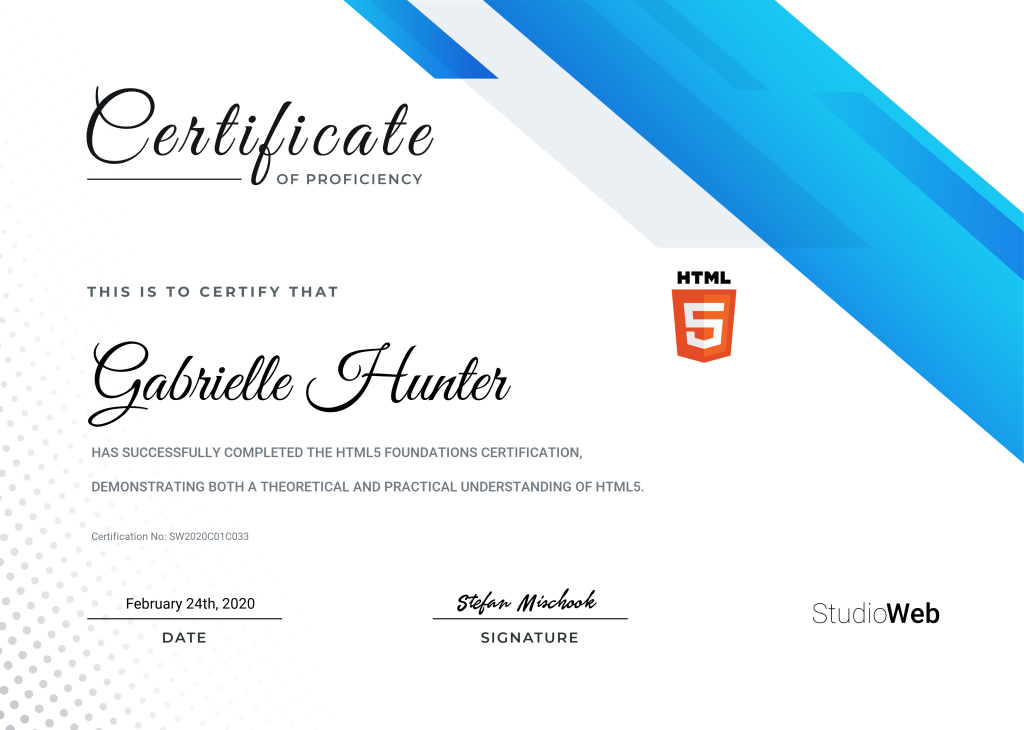
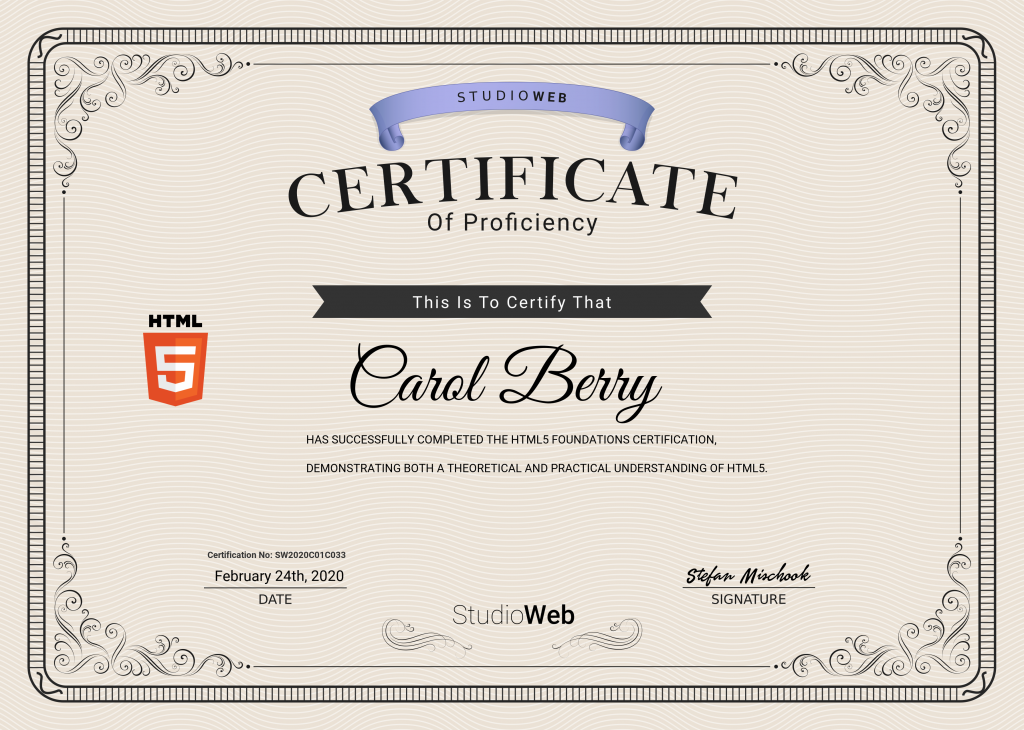
We also have certifications in the above languages at an extra cost of $35/student per certificate. Though we have been providing certification services for schools since 2011.
Here are some samples of the printable certification students will earn when they pass a certification exam:
What is the quickest and easiest way to learn React JS? The key is to learn the web fundamentals.
Full transparency here, we’re going to be talking ourselves up a bit and shamelessly plugging our courses, because we got a question that directly references them. Our questioner (questionee?) was wondering if it was easy to jump into React after taking our WebDev (web development) course?
Quick (but not necessarily deep) jump into React:React (also known as React. js or ReactJS) is a JavaScript library for building user interfaces. It is maintained by Facebook and a community of individual developers and companies. React can be used as a base in the development of single-page or mobile applications.
And as for how easy or how much of a ‘shift’ it would be to jump into React after learning with our web development course? “[My WebDev course] …is designed to give deep knowledge that you can use to pivot into many directions. React, of course, is a natural progression because you need to know JS (JavaScript), HTML, CSS, and the web in general: I teach all this and much more”.
This also speaks to something that’s been mentioned a lot on these VLOGS and articles, so much so, that’s it should be considered one of our mantras here: “the key to becoming a great developer quickly is to master the fundamentals. I teach the fundamentals. Painstakingly put in a lot of effort to make my fundamentals courses very, very thorough; you’re going to see that they cover so much more than any tutorial out there could possibly cover, and that’s because of the nature of the courses.” That includes HTML5, CSS3 and of course, JavaScript and once you have those basics down, learning React JS will be easy.
So yeah, we’re blowing our own horn a little, but hey, we put in the work and it’s nice to reap the rewards. The reward being in this case, knowing that this person is going to have an easier time learning something they really want to learn (possibly getting a better job), and that our course(s) helped them!
Check out the VLOG for some more insight and check out our links down below to the courses offered. We want them to work for you so we took the time to do it right. Believe us, we gain nothing as a business if you learn nothing, it’s worth a look! -Enjoy!
The state of the ‘developer ecosystem’ in 2019 by software development company of note: JetBrains.
In the beginning of 2019, JetBrains -a software company whose tools are geared towards software developers and project managers- polled almost 7,000 developers to identify the State of the ‘developer ecosystem’. The resulting article can be found here, in all its glory, but we thought we’d break it down for ya and give you some of our thoughts…
-Java is the most popular language. “Most developers will use multiple languages, so …it’s kinda silly to get caught up in what’s the most [popular].
-JavaScript is the most used overall language. “That makes sense because JavaScript’s in the web browser, if you’re doing React, Angular, if you’re doing a basic website, you’re going to be using JavaScript.”
-‘Go’ is the most promising programming language. “I would put ‘Go’ on a ‘perhaps to learn’ list. …The top languages to learn are HTML, CSS, JavaScript, Python…”.
-TL;DR.“One thing that you see across all the surveys, that JavaScript, Java, Python, HTML, CSS … SQL, these are all coding languages and in some cases programming languages that are always at the top or near the top of the stack. And another takeaway that were on all the surveys is that the web stack is still by far dominant.”
The VLOG goes into more detail, with more educated extrapolations and a sweet scenic boat or canoe ride. -Enjoy!
Whether you’re learning CSS or anything in general: give your mind time to assimilate the lessons.
Learning anything can be hard, but learning CSS (which is not a particularly intuitive system) can be just plain daunting. What do you do when you feel like your brain is getting ‘fried’? Take a break, man!
“Learning something new is very much like exercising: lifting weights/working out. Anybody who does regular exercise knows that the rest period in exercising is just as important as the exercising itself.” For example, let’s say you do some heavy weight-lifting and the next day you’re sore…should you go on that same day and lift some more? Contrary to popular ‘bro’ opinion…NO, you should take that day for your body to rest and relax, so that when you go back to lifting, you’re refreshed and ready.
“The exact same thing applies when you’re learning CSS, …etc. You are literally tasking your brain in a physical way to learn, to acquire, to assimilate new knowledge. And because of that it’s going to reach a certain point where it needs a time to process this and assimilate it properly, so that means that you need to rest; so when you come to a point when you just can’t, it can’t sink in anymore: where the information is just becoming more difficult -your brain seems to be resisting the acquisition of new information (it’s becoming strained!) – at that moment, it’s your brain saying, ‘okay, we’ve trained enough, it’s time to take a break to assimilate.”
Check out the VLOG for a very understanding and meaningful deep dive into this subject. Don’t beat yourself up over how long it’s taking to learn either. That will not matter once you’ve attained your goal, and no one out there in the real world cares how long it took for you to learn something – they just want to take advantage of your knowledge. <Shameless Promo> Our courses, whether it’s the freelancing course or the web stack, or any of them are designed in a way that takes advantage of the fact that you’re learning at your own pace. So no worries, take your time, do it right and be good to yourself. -Enjoy!
What are the top 10 programming (and coding) languages do employers want?
According to job listings on indeed.com as of may 16, 2019, we have the top 10 programming and coding languages that will get you hired. That’s right, sometimes the languages you enjoy and frequently use or swear by may not necessarily get you hired, but if you have experience with any of these top ten, you’ll have a job…at least until the end of 2019.
So what are the top ten, you ask? Well, if you’ve been following the VLOG, it’s not really a surprise… 1. Java 2. SQL 3. JavaScript 4. Python 5. HTML 6. CSS 7. C# 8. C++ 9. Ruby 10. PHP Bonus tip: While Java is at the top and you’ll have work for decades with it, Google has announced that they will be using Kotlin (while still offering support for Java) going forward. So, if app development for Android is your thing, ya might wanna look into that.
The VLOG goes into way better detail regarding the rankings, and of course, what would a VLOG be without some nice shots at Ruby for the #9 ranking! -Enjoy!
Wix is another tool that web designers can use to build out simple client websites and for some client websites, using Wix just makes sense.
When it comes to building websites for clients most devs will turn to CMS giant WordPress but there are other less complicated web-builders out there like Wix, SquareSpace, Weebly, etc. that generally let you create websites easily at the cost of versatility. And that’s not altogether a bad thing, depending on what the client’s needs are.
And from these sites that offer simplicity and ease have risen freelancers in their own right. “If you look at Wix today or shopify…even though they’re much easier to use than, let’s say building from scratch: using a template or something, it’s still something that many small business owners don’t want to tackle. …In terms of freelance work, I call it becoming a web professional. A web professional is not necessarily somebody who is a developer (although they could be), …[It’s] somebody who knows how to put up websites, knows the different options; knows how to build from scratch, …you understand when those types of builders make sense, …hosting options, …domain names …this is what a web professional brings to the table.”
Don’t call Wix and the other builders a niche – I’ve been here for years, rockin’ my peers, puttin’ others in fear…okay seriously though, “…because it’s such a huge demand, this type of freelancer is gonna make a lot of money because there’s so many small businesses out there who are positioned on the web in some form or another and they don’t have all this knowledge, they don’t understand the differences between these different platforms and they’re probably not aware of most of these platforms…”
So should you consider using Wix, shopify, etc when choosing how to service client(s) demands over WordPress? “So your job as a consultant/web professional is to direct them in the right direction. Shopify, Wix, SquareSpace, etc. they’re not competition, they’re not taking away from web design and development, they are just tools in your toolbox. …Go in there first [and] talk to your client: see what their needs are and then you as a web professional can determine whether or not the Wix platform can support that.” As previously mentioned, “the thing about these web builders… they’re typically limited: the simplification comes at the cost of flexibility. …When you simplify you usually remove options that you have on the table. So you have to determine whether you need those options or not; maybe you don’t/maybe you do…”. Hey, we never said it was gonna be easy…
The VLOG goes into a way better explanation, you should check it out. And maybe while you’re at it <shameless promo> check out the really cool and thoughtfully put together courses that we offer. Whether is freelancing, or learning web development, you’ll be taking advantage of almost 3 decades of experience in all these subjects AND if you click here, you can take advantage of a super deal! We’ve teamed up with InMotion hosting for a really amazing offer where they essentially pay for you to take my course and learn how to become a web developer. Links to all these offers are below as well. -Enjoy!
Is Microsoft starting to embrace ‘openess’ in it’s push towards the web platform?
A couple of months back Microsoft announced their new ‘Fluid’ framework and we read off the intro from an article at the beginning of the VLOG at the bottom of this page, so we’ll spare you that here… But what makes this announcement interesting is that Microsoft seems to be moving away from native apps, systems, etc and embracing a more ‘open’ operation. It’s even “…going towards the web platform, …it’s embracing web technologies: think html5, css3, javascript versus native development…”.
This is something we’ve touched on in past articles and even dedicated a whole VLOG to here, and Microsoft is just another great example: “…when you’re not sure which way to go, always go for the open technologies, …because open technology typically wins out over closed technology”.
We even went so far in a past article to say the native development languages like ‘swift’ for iOS or ‘kotlin java’ for android were going to go down to the open web technology solutions. Now we’re not saying that we know it all or that maybe we have the gift of premonition or anything like that, but it looks like Microsoft seems to be having a ‘premonition’ of their own…
The VLOG, of course, goes into more detail and is worth checking out but we want to let you know about a really cool offer by clicking here. We’ve teamed up with InMotion hosting for a really amazing offer where they essentially pay for you to take my course and learn how to become a web developer. Links to the offer below as well. -Enjoy!
GitHub is a good indicator of how popular programming languages are.
GitHub is an American company that provides hosting for software development version control using Git and it is a subsidiary of Microsoft. The article we got this list from is here and it’s pretty much the usual suspects…
Check out the VLOG for our take on the list and a little bit of info on the entries. -Enjoy!
…That’s ‘Positive Mental Attitude’ for ‘Progressive Web Apps’…
We keep on getting requests to cover PWA/RWD’s and because we’re not DJs or that small band at the back of the bar that’s playing ‘only originals’, we’re taking those requests…and 5-6-7-8…
So a PWA is a progressive web app and an RWD is a responsive web design. How are the two related? Well first off, “RWD is basically writing your HTML5 and your CSS code so that the layout of the site will flex and change depending on the size of the screen of the web browser that is visiting your site. So if you have a smartphone or a 75 inch flat panel TV, a properly coded responsive website or web app will look just fine.” So the idea being that fonts, images, layout, etc. will change size depending on the size of the screen you’re viewing them on. As you can imagine, with the way consume data and media, it was a pretty big deal.
Okay, but where does the PWA come in? “…A PWA is basically taking RWD to its ultimate highest level. Essentially…you can think of it as RWD on steroids, because it brings in all the power that comes with native HTML5 and CSS (and you throw in some JavaScript to add some extra capabilities, of course…).” “The big advantage of using a PWA over native is you have one code base, so instead of having to write one app in iOS with SWIFT, and then having to write the whole app again from scratch for android in JAVA or KOTLIN. PWA is a lot cheaper to get your app out there, and [while] you don’t get the full benefit with a PWA that you get with native, you get a lot of the benefits.”
Now the VLOG will go into really good detail weighing the pros and cons of PWA or native (and believe me there are way more pros), but as a dev or a freelancer you should always be thinking about where businesses are coming from. Most of the time they’re not interested in the “nerd” implications of the languages, frameworks, etc. that you use, they just want to get up and running fast and get the product or service out there and PWA is your best bet. -ENJOY
The belief that the cutting edge tech must be the tech you use in your projects.
You may have heard your dad or your grandpa say something pretty close to this while grumbling about cars, phones or television sets; and that’s ‘shiny and new isn’t always better’. “As beginners you hear about this new technology is so great, that new technology is so great, etc, etc, and you can get overwhelmed and caught up with all this. …It’s chasing the illusion of perfection.”
And no demographic is more vulnerable to this illusion than young developers. For ease (and fun) let’s refer to this demographic as “noob” developers. “…[Noob] developers will chase perfection in their application development looking for ‘the better language’, or ‘the better framework’.” No only is this a waste of precious time but also a brisk jaunt into the realm of madness. “Don’t get me wrong, there are frameworks that are more ‘mature’ [or] ‘better’ than other frameworks given the application that you want to build. [For example]…If you’re building an AI based system, you’re not gonna wanna do that with PHP…you could…people have done machine learning with PHP – I wouldn’t do it – no, no you do PYTHON because that’s where all the action is, that’s where the market share is: that’s where it’s ‘mature’. …[But] you’ll find that any of the prominent frameworks and languages out there today…they’re going to produce good work…whether the app is good or not is up to you.”
Break your foot off on this VLOG for a very in-depth (and tangent-filled) dive into the “new tech trap” and remember, “in general all these frameworks and languages have pros and cons and everything looks greener on the other side of the fence until you get there.” -Enjoy.