First things first, a kick-ass opening for this vlog with a (literally, for those afraid of heights) breath-taking view of Montreal, and then back into the “studio” to check out my rig (drums), all to a slick tune in the background. Maybe we’ll call this segment, “Weeee, so fly.”
But let’s dive right into it… Should you use JAVA for back end web app development?
A very specific question deserves a very specific answer: “At the end of the day you have to always judge your technology stacks based on both technical implications of the choice and market implications.”
Technology implications: Do you have experience with the language you’re using? Are you comfortable as programmer? “It depends how nerdy you are, if you are very comfortable writing code, you’re very comfortable as a developer and you’ve done web apps before, yeah, JAVA, could be a good choice, but you gotta consider more than just the technical aspects of the language…”
In terms of market implications: “…are there jobs there? Is there a long road ahead for that particular technology stack?” Now, there are plenty of jobs in JAVA but they tend to be in or with larger businesses/ organizations. Even with smaller businesses or freelance work “JAVA would not be my first, second, or third choice…”.
Check out the video for a super detailed answer to this question and the more broad lesson that we’re trying to teach: What can you do Vs. what will the market pay you for. Also, did you find our RUBY diss(es)? Oh, yeah, there might be more than one! Enjoy!
As predicted, Flash has now gone HTML5 – yes, you can now export your Flash work to HTML5 using the new Flash CS6.
I haven’t had a chance to look at it, so I have no comment with regards to how well it works. Nonetheless, this is more evidence that HTML5 is going to be huge in the future of web design and web development – if it isn’t already!
Flash CS6 basically uses the CreateJS open source framework, to output animations in Flash. I don’t know how powerful this conversion process is yet … we will soon see how complex the Flash projects can be and still be able to output them via HTML5.
Today, the Web is a much more sophisticated place (dynamic shopping carts, blogs, DOM scripting, Ajax etc) … a Web that requires much more sophisticated web designers. To be a competitive and modern web designer these days, you have to learn more than just HTML and CSS .
The ‘foundation’ languages of web design today are:
You don’t have to become a full-fledged nerd coder but you should at least understand the basic concepts and be able to read and write basic scripts. This way, when a client or your boss comes to you with some shopping cart script that he wants you to install … you wont be freaking out because you don’t understand a thing.
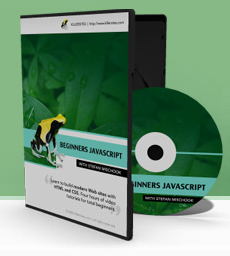
So in keeping with my goal of training you guys and girls up, I just wanted to announce my latest video tutorial; a course on Javascript: Beginners Javascript.
… OK, not the most exciting title, but the video tutorials are perfect for people new to programming. Some details:
Beginners Javascript is designed to teach total beginners Javascript programming. By the end of the 5 hrs of video training (over 39 individual videos) you will feel comfortable reading and writing usable Javascript code for everyday web tasks like spawning windows, validating forms and creating simple page effects.
The table of contents:
Introduction (10:09)
First Javascript (10:21)
What is a programming language (6:18)
Javascript event handlers part 1 (8:58)
Javascript event handlers part 2 (6:40)
Javascript event handlers part 3 (4:50)
Javascript errors part 1 (6:39)
Javascript errors part 2 (4:39)
Javascript variables part 1 (10:53)
Javascript variables part 2 (10:01)
Javascript execution (4:21)
Javascript functions part 1 (8:46)
Javascript functions part 2 (6:22)
Javascript functions part 3 (6:32)
Javascript functions part 4 (9:27)
if statements part 1 (7:33)
if statements part 2 (6:52)
if statements part 3 (8:55)
Javascript loops part 1 (8:25)
Javascript loops part 2 (5:58)
Javascript object; a birds eye view (8:31)
Javascript arrays part 1 (3:36)
Javascript arrays part 2 (7:44)
Javascript arrays part 3 (5:28)
Javascript functions cont. part 3 (8:13)
Javascript functions cont. part 4 (10:16)
Javascript functions cont. part 4-b (9:57)
Javascript functions cont. part 5 (9:18)
Introduction to the DOM part 1 (8:31)
Introduction to the DOM part 2 (3:37)
Javascript forms part 1 (14:50)
Javascript forms part 2 (15:10)
Javascript forms part 3 (6:58)
Javascript forms part 4 (8:51)
Creating a toggle menu part 1 (6:59)
Creating a toggle menu part 2 (10:39)
Linking to external Javascript files (5:46)
Spawning windows with Javascript (9:24)
Javascript frameworks, conclusion to course (4:24)
The DOM is short for: Document Object Model. This is basically a virtual map of the currently loaded web page. You can use this map along with the help of Javascript, to travel about your web page and do things like:
Insert tags
Remove tags
Insert text
… And a whole lot more.
The DOM is the key to all those cool Javascript and Ajax affects that we now see all over the Web. Check out my new video that introduces you to the DOM and I also teach you an exercise I came up with to help you better understand the DOM:
1. Basic object oriented concepts.
2. The Javascript object hierarchy.
The goal of this video is to give you a birds eye view of Javascript, to hopefully make it easier to understand how to use this language in later videos.
I just released and brand new course on the Javascript framework called jQuery. JQuery is a very popular Javascript library that many web designers will find themselves working with.
You can find about 40 minutes of free videos from the course here:
I just wanted to make a quick announcement: I’ve released about 40 minutes of new video tutorials on beginners Javascript. Check out my new micro-site:
This is a ‘sneak peak’ of a new video tutorial course that targets total beginners to Javascript and programming in general. If you want to learn Javascript, I think these videos will be helpful.
These videos are not designed to be a tutorial, but rather, they are a lecture. None the less, these videos can help give you at least a basic understanding of what Ajax is all about.
Anyway, they are free, so what do you have to loose!
😉
If you guys want a proper killersites style (simple, practical and to the point) video tutorial, please let me know.
A while back a wrote a JavaScript script that automatically styled an HTML table. In a nutshell, the script automatically changes the background color of every 2nd row in an HTML table.
Anyway, someone recently sent me an updated version of the script. You will probably want to read the original article before looking at these changes.
From the email:
I did some simplification on the code for zebrastripes. I don’t bother with the last array bit because TR elements have the bgColor attribute.

 Hi,
Hi,